
Confused about the real-world benefits of going modular? You aren’t alone. In our experience at Mohave Homes, the terms “manufactured” and “modular” are often used interchangeably, but for Arizona landowners, the difference between the two can determine everything from where you can build to how much your home is worth in ten years.
While we proudly offer both options, understanding the specific advantages of International Residential Code (IRC) modular homes is crucial if you are looking for site-built appreciation with significantly faster construction timelines. Here is why modular homes are becoming the preferred choice for savvy buyers across the Grand Canyon State.
The Core Difference: It’s All About the Code
To understand the value of a modular home, you have to look past the floor plan and look at the building stamp. The primary distinction lies in the building code governing construction.
- Manufactured Homes: Built to the federal HUD Code. These are federally regulated and come with a red HUD tag.
- Modular Homes: Built to the International Residential Code (IRC). This is the exact same building code used for traditional site-built (stick-built) homes in Arizona.
Because modular homes are built to the IRC, state and local municipalities view them as identical to a home built from scratch on your lot. As noted by the International Code Council, once an IRC modular home is placed on its permanent foundation, it is indistinguishable from a site-built home in the eyes of the law, inspectors, and most importantly, appraisers.
For a deeper dive into the technical specifications, check out our breakdown on Manufactured Homes vs. Modular Homes: What’s the Difference?
One of the biggest hurdles our customers face is restrictive zoning. You might find the perfect plot of land in Golden Valley or Kingman, only to discover the deed restrictions or HOA rules explicitly prohibit “mobile” or “manufactured” homes. This is where modular home zoning AZ regulations work in your favor.
Because modular homes meet local building codes (IRC), they generally cannot be excluded from zones designated for single-family residences. While specific CC&Rs (Covenants, Conditions, and Restrictions) can still dictate architectural styles or minimum square footage, a municipality generally cannot ban a modular home simply because it was constructed off-site.
This opens up vast inventory options for land buyers. You can purchase a lot zoned for standard residential use and place a high-quality modular home there, bypassing the restrictions that limit manufactured housing to specific rural zones or parks.
Do Modular Homes Hold Their Value?
The short answer is yes. When it comes to modular home value Arizona market data is clear: modular homes appraise the same as site-built homes.
According to the Appraisal Institute, appraisers are trained to evaluate homes based on construction quality and code compliance, not the method of delivery. Since modular homes are permanent structures on permanent foundations, they are considered “real property.”
The Financing Advantage
Unlike manufactured homes, which sometimes require specialized FHA or chattel loans depending on the foundation type, modular homes qualify for the exact same mortgage products as site-built houses:
- Conventional 30-year fixed mortgages
- Construction-to-permanent loans
- VA and USDA loans
This access to traditional financing usually means lower interest rates and better resale potential down the road. If you are weighing the long-term financial picture, you might find our Manufactured Home vs. Site-Built Home in Arizona: Complete Cost Comparison 2026 helpful to see how the numbers stack up.
The Speed Factor: Move In Months Sooner
In Arizona’s current construction market, building a custom stick-built home can take 12 to 18 months—assuming you can even find a contractor available. Modular homes shatter this timeline.
Because the home is constructed in a climate-controlled factory at the same time your site is being prepped, we can reduce the completion time by up to 50%.
The Parallel Process:
- Month 1-2: We finalize permits and floor plans. Your land is graded, and the foundation is poured.
- Month 2-3: While the concrete cures, your home is built, inspected, and finished in the factory.
- Month 4: The home is delivered, set by crane, and utilities are connected.
As detailed in our guide on the 16-Week Manufactured Home Timeline, this efficiency doesn’t just save time; it saves money on construction loan interest and rental costs while you wait.
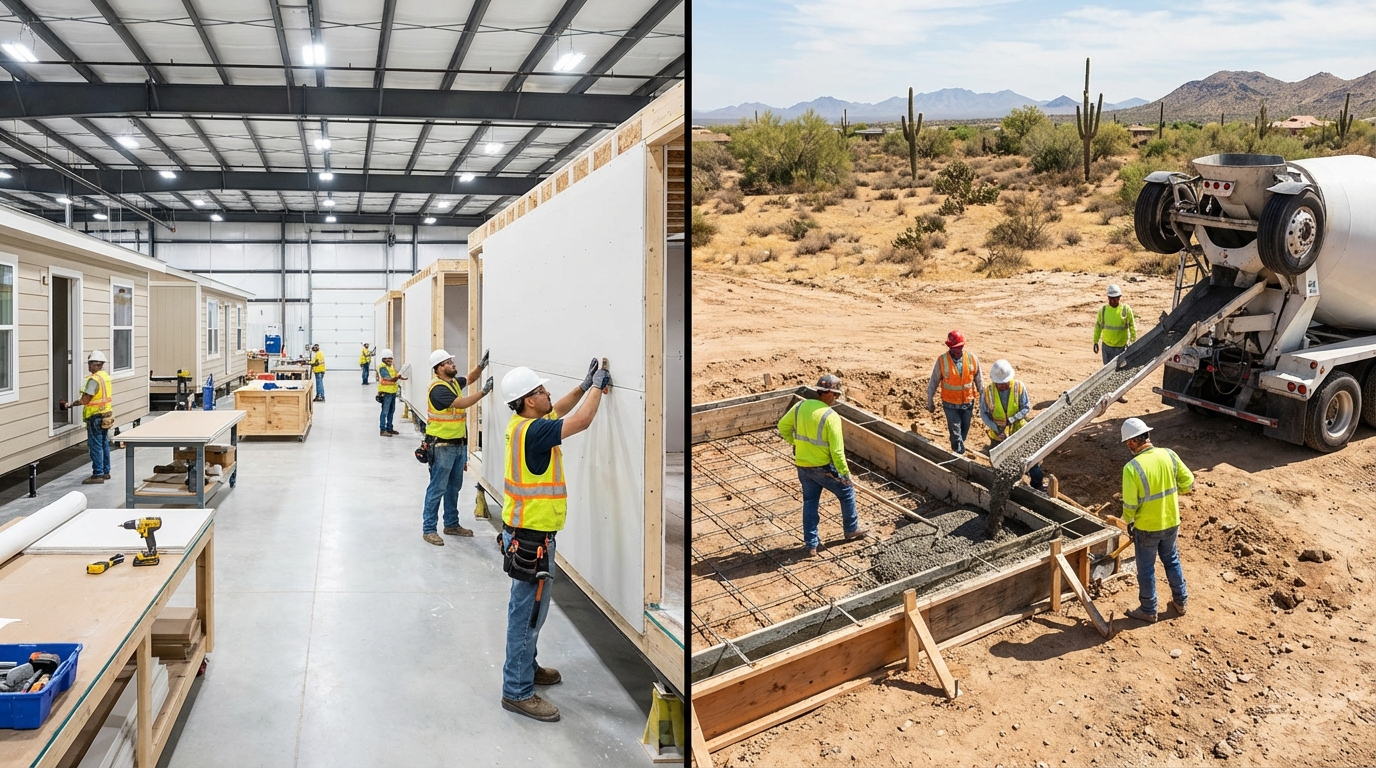
Quality Control and Efficiency
Arizona’s harsh climate—blazing sun in the summer and monsoons in the late summer—can wreak havoc on site-built framing. Wood that sits exposed to the elements for months can warp or absorb moisture.
Modular homes are built indoors. Materials remain dry and straight. Furthermore, factory construction allows for tighter building envelopes, which translates to better energy efficiency. In a state where air conditioning is a survival necessity, a tighter seal means lower monthly utility bills.
Is a Modular Home Right for You?
Choosing between a manufactured (HUD) home and a modular (IRC) home often comes down to three factors:
- Budget: Modular homes typically have a higher upfront price per square foot than manufactured homes (though still lower than site-built).
- Zoning: Does your land require IRC construction?
- Future Goals: Are you looking for maximum resale appreciation or the lowest monthly payment?
If you own land in a restrictive zone or want a home that builds equity exactly like a traditional house, modular is likely your best path.
Ready to Explore Your Options?
At Mohave Homes, we specialize in helping Arizona buyers navigate these technical choices. Whether you need a HUD-coded home for a rural lot or an IRC-modular home for a subdivision, we handle the logistics from permits to final keys.
Let’s review your land’s zoning and find the floor plan that fits your future. Contact us today to get started.

